
PRACTICAL WRITING FOR
SHOPS THAT CUT CHIPS
Switching guides, quality, job costing, and document AI — written for
owners, shop supervisors, and controllers in oil & gas services. No fluff,
no stock photos of handshakes.

DESIGN
Billing the hours your designers already work
In most shops, design time is a favor: quoted loosely, tracked nowhere, absorbed silently. Treat it like machine time and the margin comes back.
PERMIT & COMPLIANCE
Permits and monograms: make the paperwork a gate, not a chase
The week before an API audit shouldn't be archaeology. When compliance documents attach where they're created and holds actually hold, the binder compiles itself.
CNC MACHINING
Your CNC cell has a math problem, not a hustle problem
Spindles are the scarcest asset in the building. Loading them by whiteboard and memory wastes the one thing you can't buy more of by working harder.
TURNING
Turning work: rhythm is the product
Lathe cells make money on cadence — bar in, parts out, inserts indexed before they chip. The ERP's job is to protect that cadence.

FABRICATION
Fabrication jobs sprawl. The work order shouldn't.
Plate, structurals, buyouts, coating, heat treat, NDE — a fab job touches half your vendors and all your floor. One work order should hold it together.
WELDING
Code welding is a records business with sparks
The weld is the easy part to inspect. The procedure, the qualification, the continuity, the rod lot — that's where audits are won and jobs are lost.
GENERAL MACHINING
Busy is not a business model: profit control for job shops
One-offs, repairs, short runs — general machining is where shops stay busy and quietly lose money. Three controls fix it.
.webp)
INSTALLATION
Installation revenue leaks in the truck ride home
The work was done, the customer was happy, and the ticket rode a dashboard for nine days. Installation margin is mostly a billing-speed problem.
.webp)
SALES
A pipeline that knows what a lead is worth before you quote it
Most shop CRMs are a list of names. A pipeline built inside your ERP knows your capacity, your margins, and this customer's history — so it can score a lead the moment it lands.
SALES & QUOTING
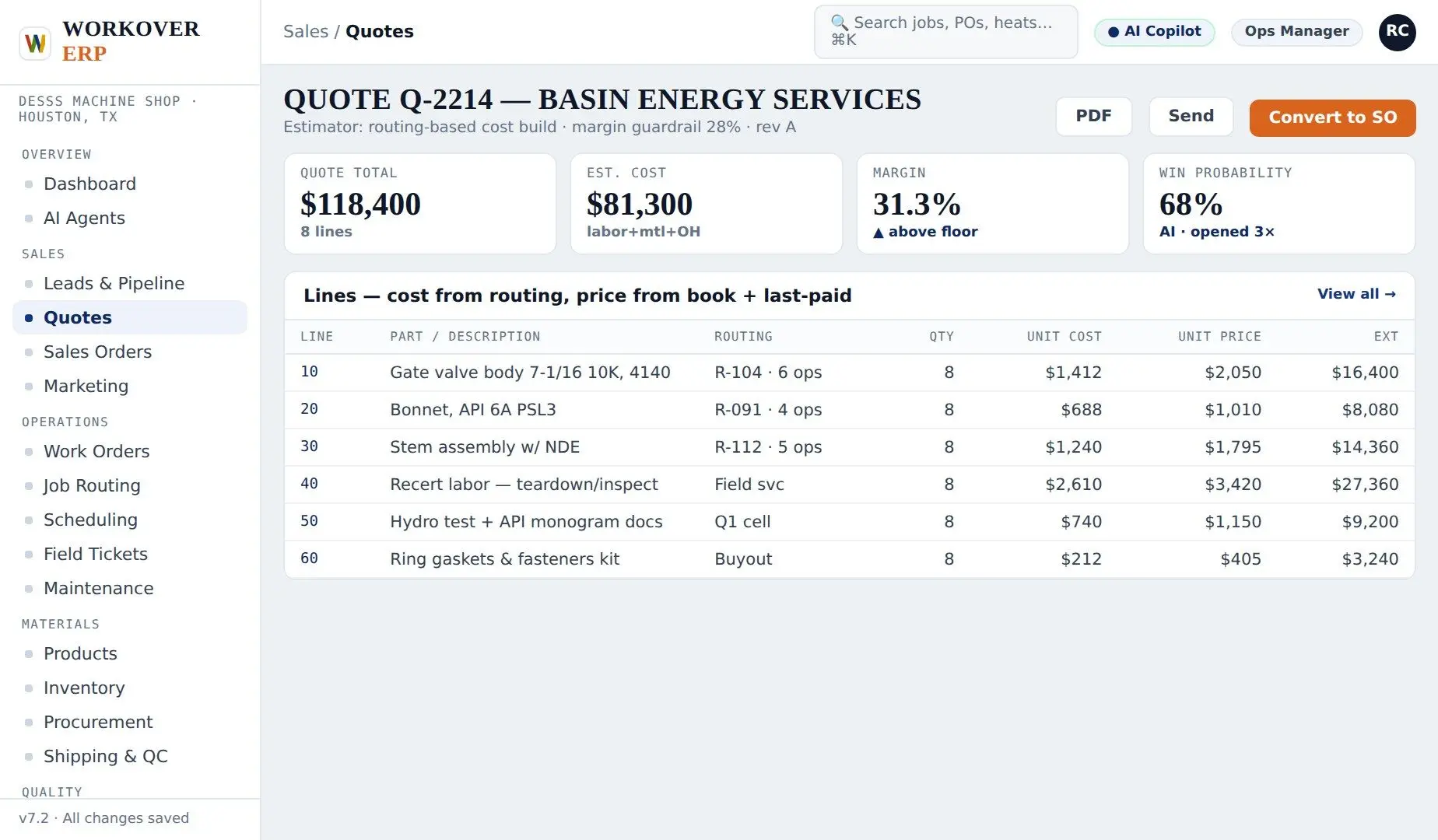
Quote from the routing, not the gut
The most dangerous number in a job shop is a price someone felt good about. Here's what changes when every quote line builds its cost from an actual routing.
CAD TO QUOTE
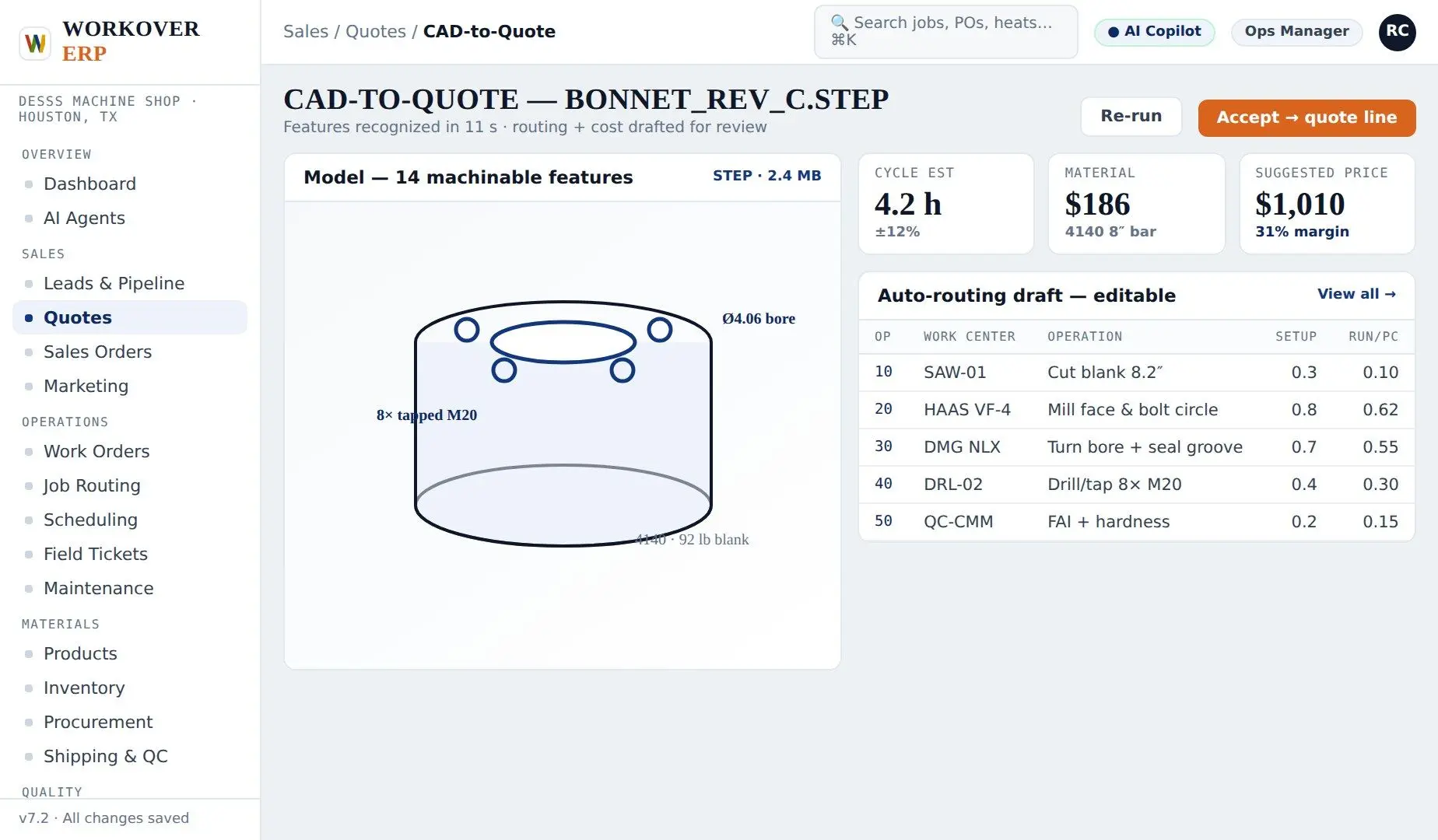
From STEP file to priced quote in one coffee
Feature recognition reads the model, drafts the routing, and prices the part — your estimator reviews instead of rebuilds.
DOCUMENT AI
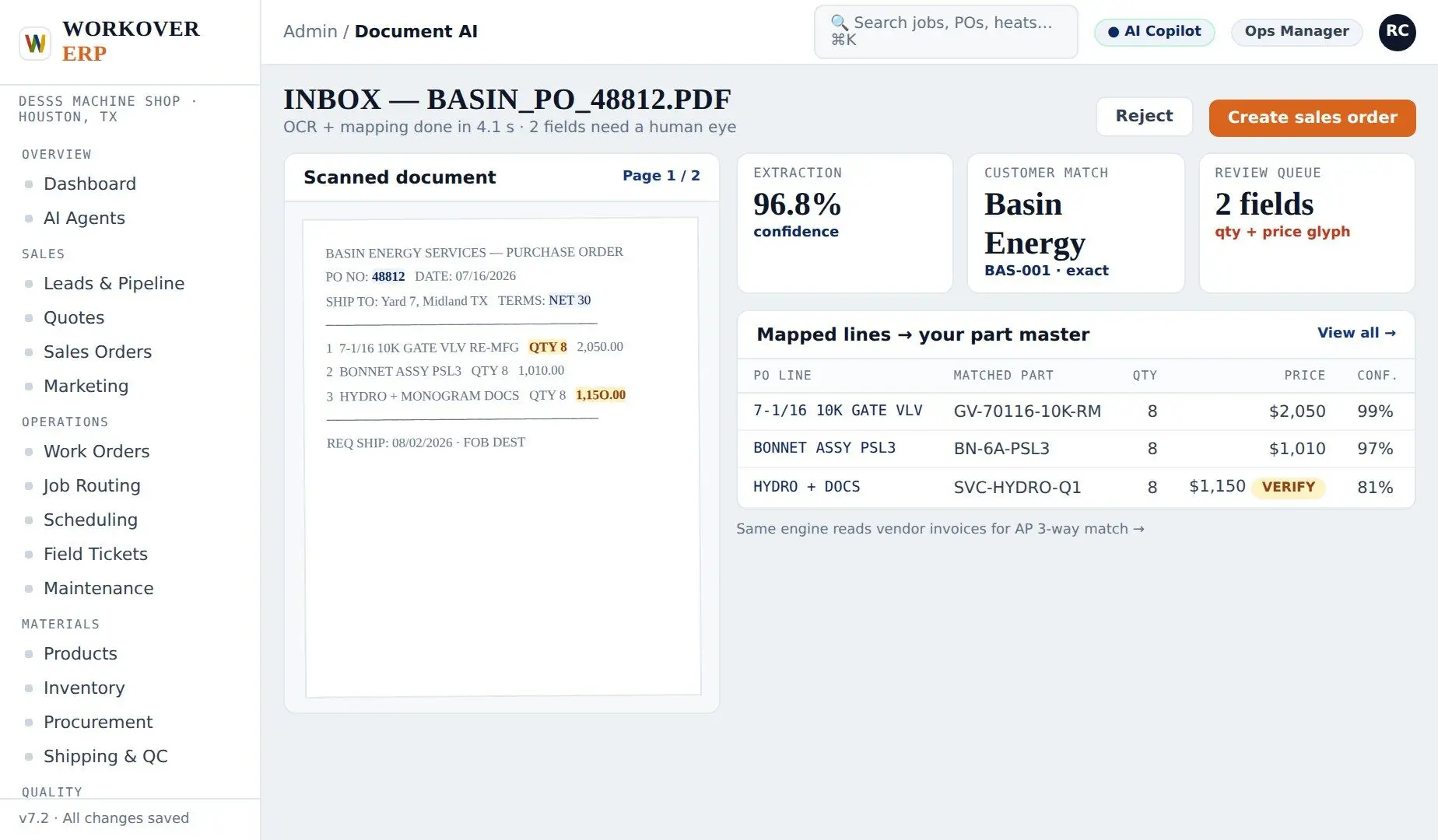
Document AI works both directions: customer POs in, vendor invoices in
The same OCR engine that turns a faxed PO into a sales order also reads vendor bills for the three-way match. Retyping dies on both sides of the house.
JOB ROUTING
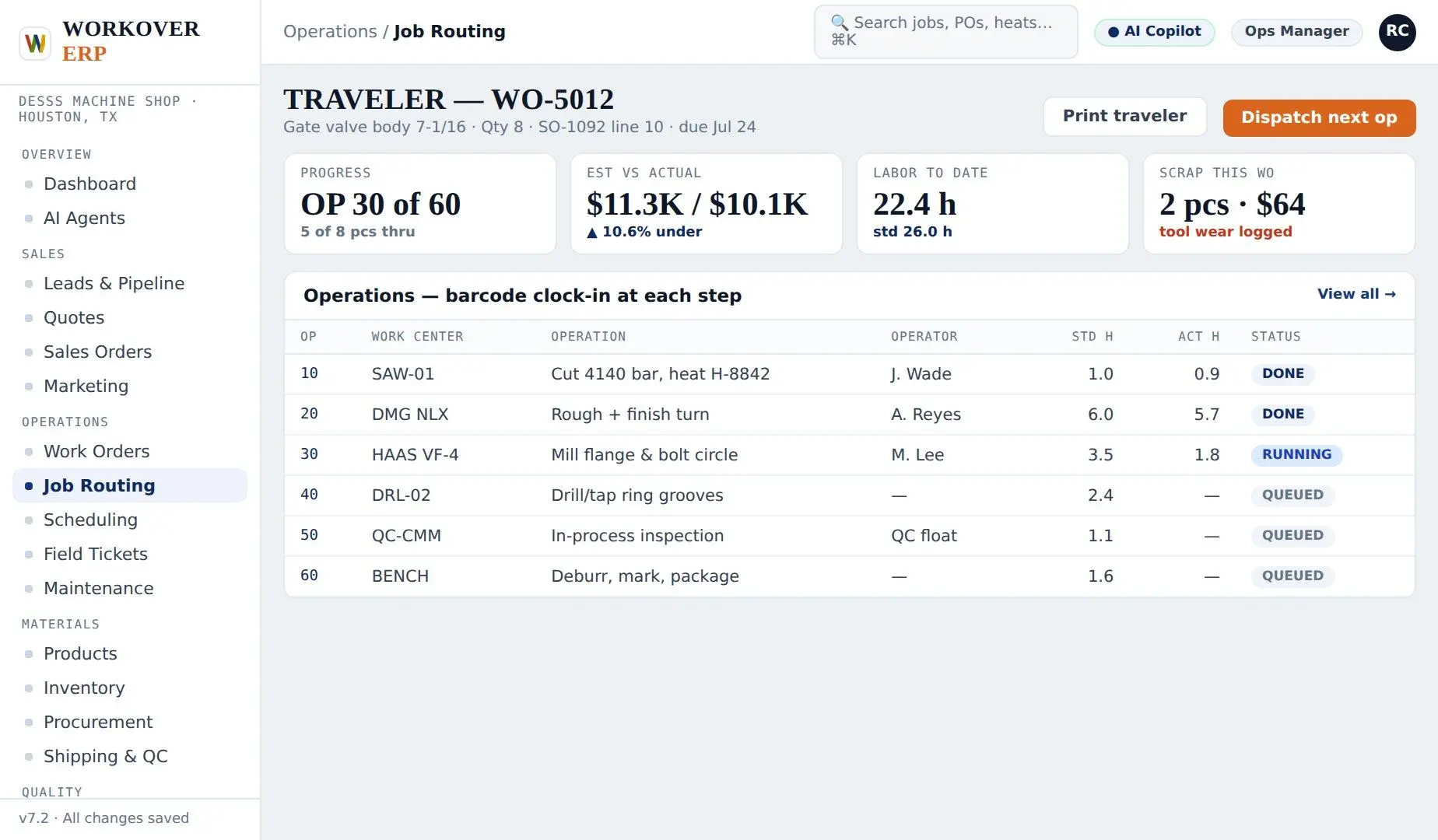
The traveler that costs itself as work happens
A routing isn't paperwork — it's the spine of the job. Standards, material, trace, and cost all hang off the operations.
SWITCHING GUIDES
Migrating from GlobalShop Solutions: a field guide for shop owners
What actually moves when you migrate from GlobalShop Solutions to Workover ERP — customers, routings, open work orders — plus the parallel-run playbook and a realistic timeline.
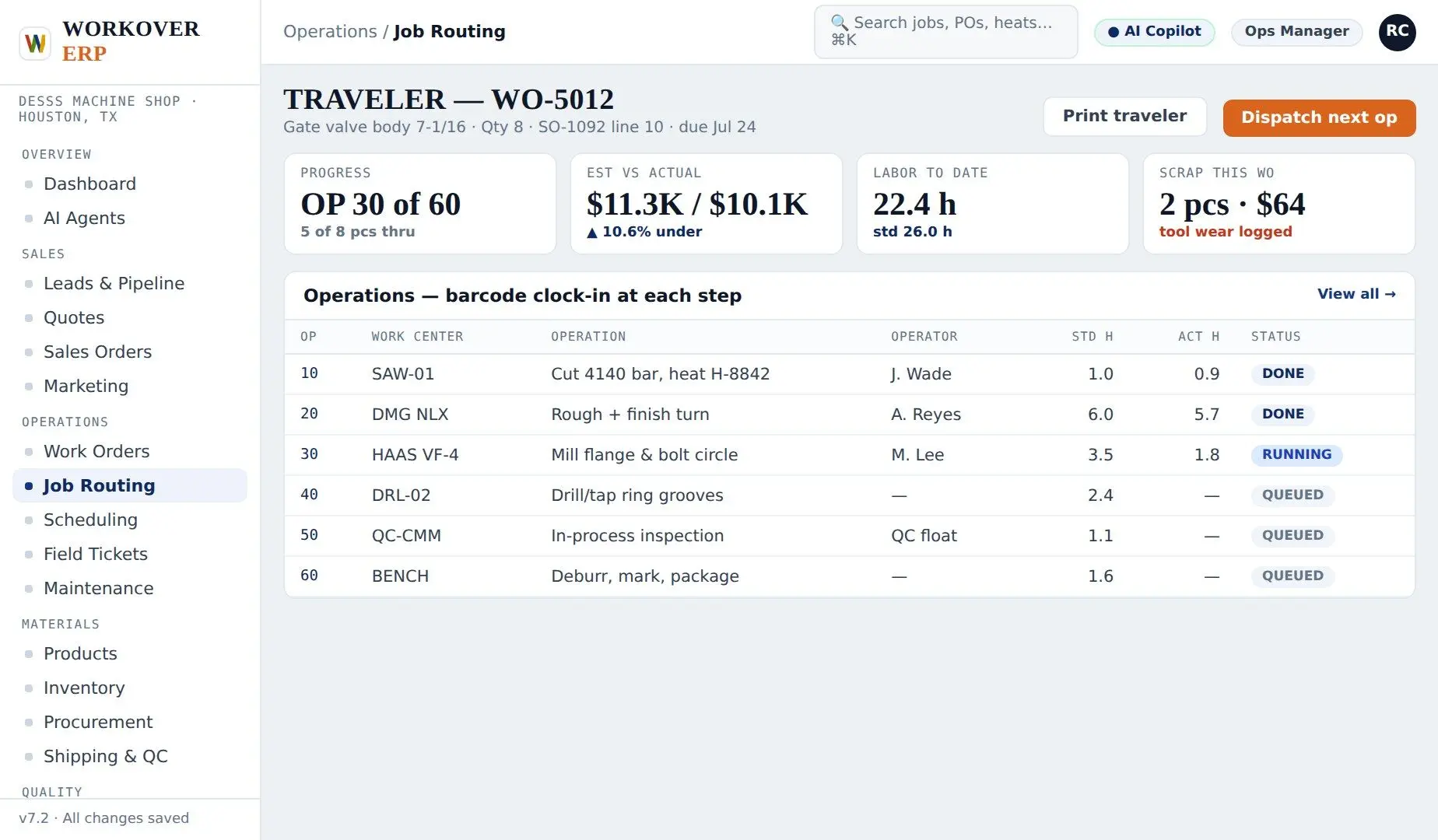
MACHINE SHOP
Machine shop control: utilization you can bill and trace you can prove
Spindle hours, scrap causes, and heat-lot genealogy — the three numbers that separate profitable shops from busy ones.
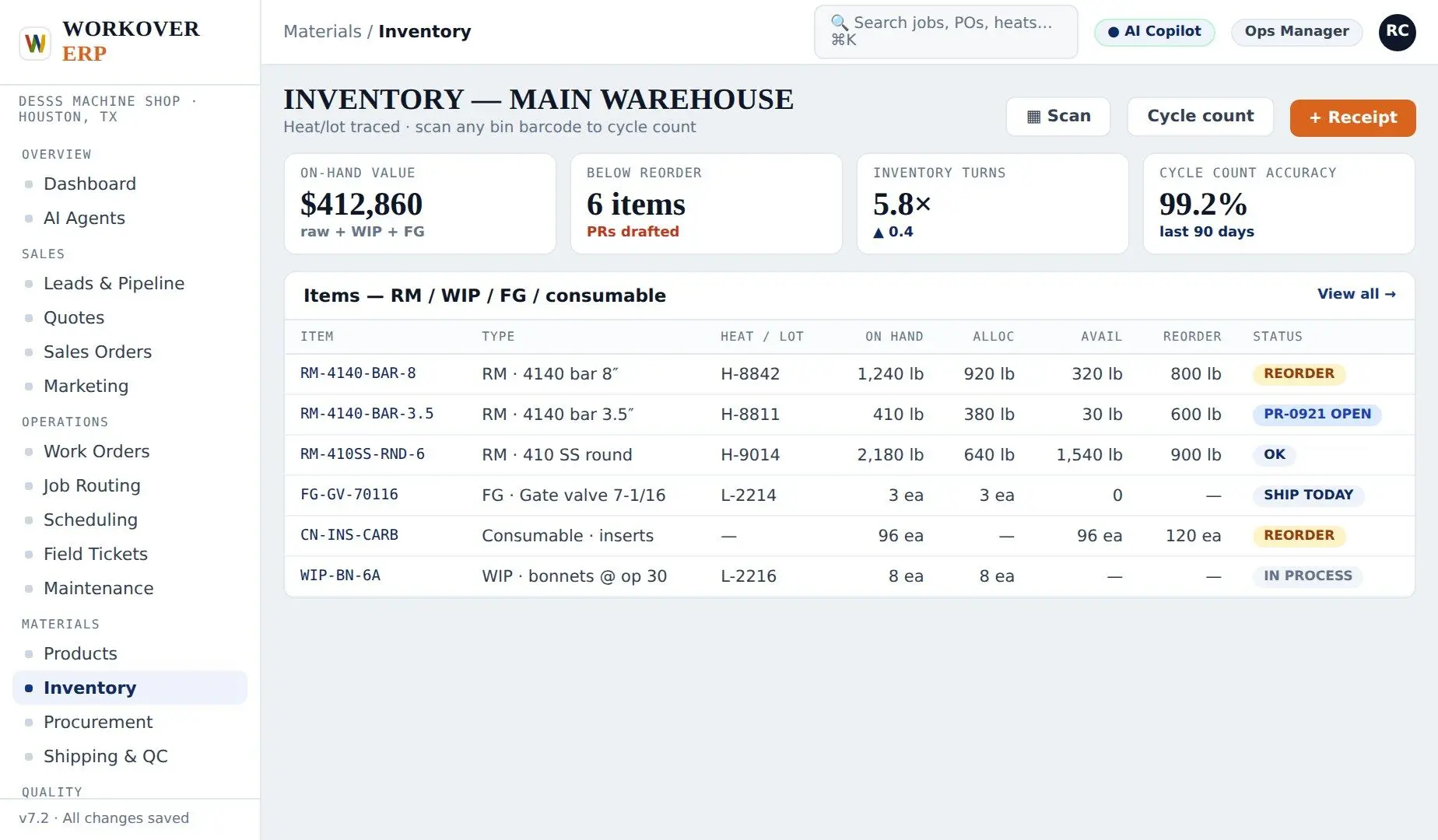
INVENTORY
Inventory that knows its heats, lots, and reorder points
RM, WIP, FG, and consumables — traced by heat and lot, counted by barcode, and reordered before the saw goes hungry.
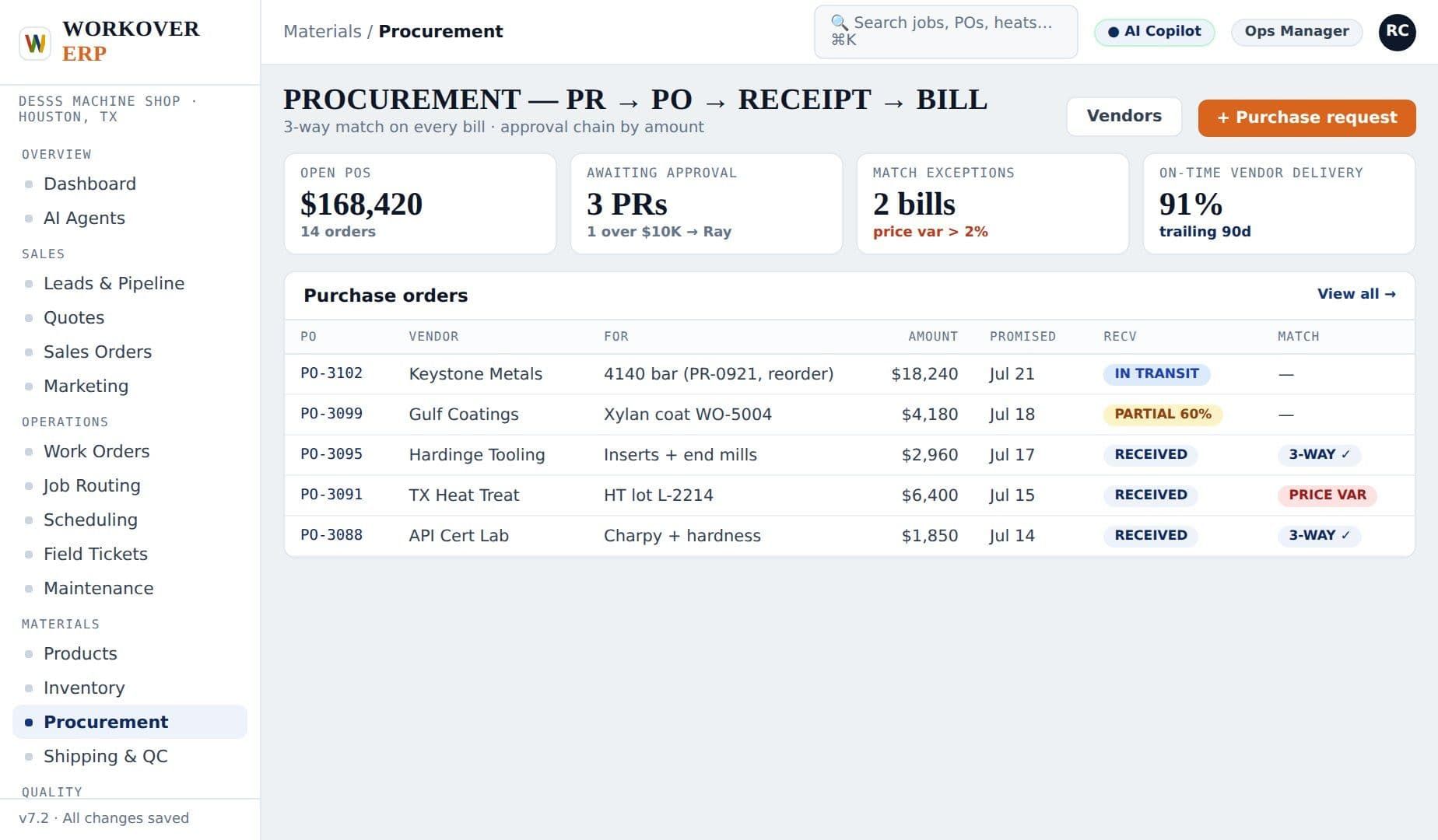
PROCUREMENT
PR to PO to receipt to bill: the three-way match nobody has to police
Purchase discipline shouldn't depend on a diligent clerk. Build the match into the flow and exceptions surface themselves.
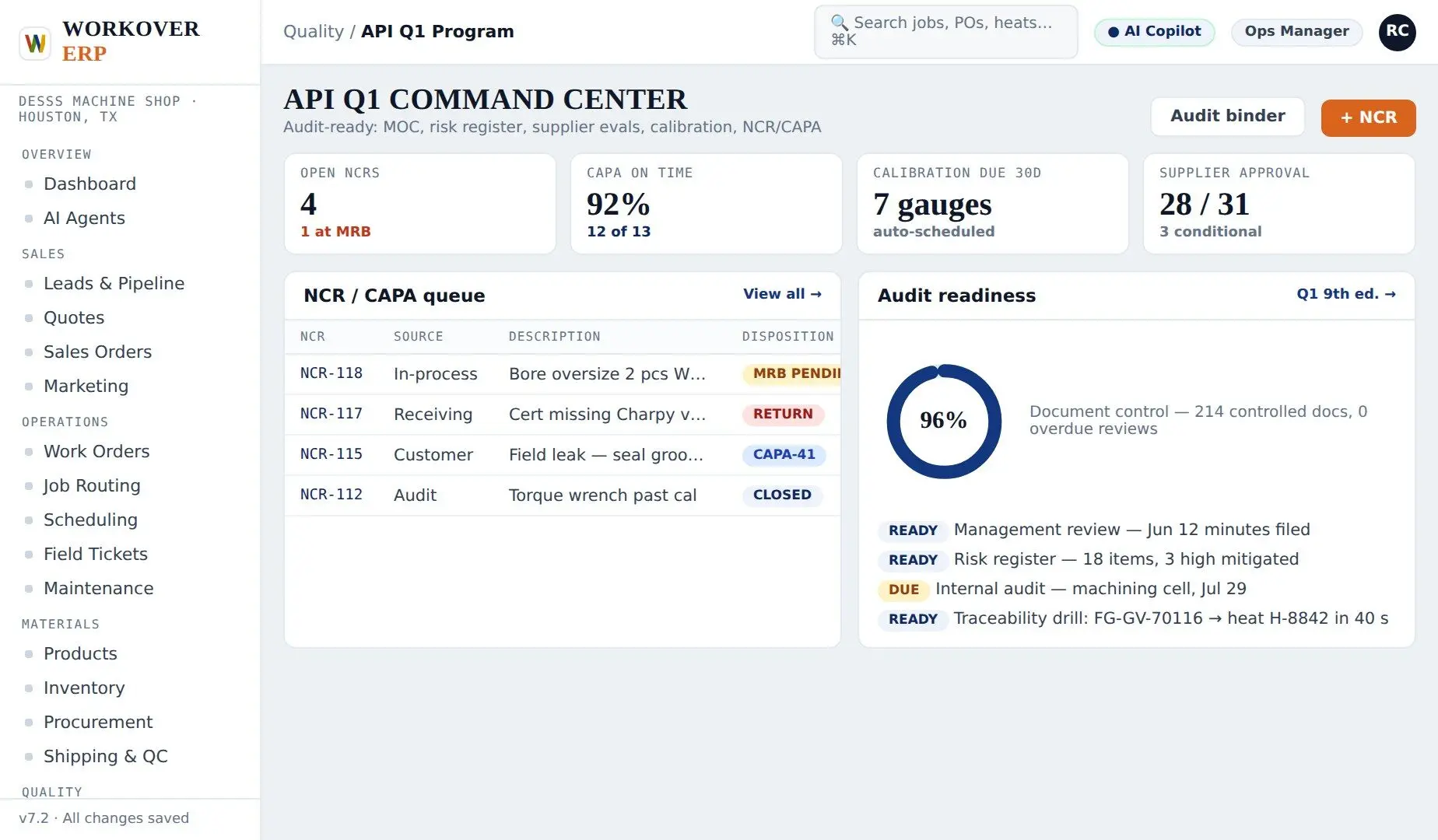
QUALITY (API Q1)
Always audit-ready: running API Q1 inside the ERP
MOC, risk, calibration, supplier evals, NCR/CAPA — when the quality system lives where the work happens, the audit binder compiles itself.
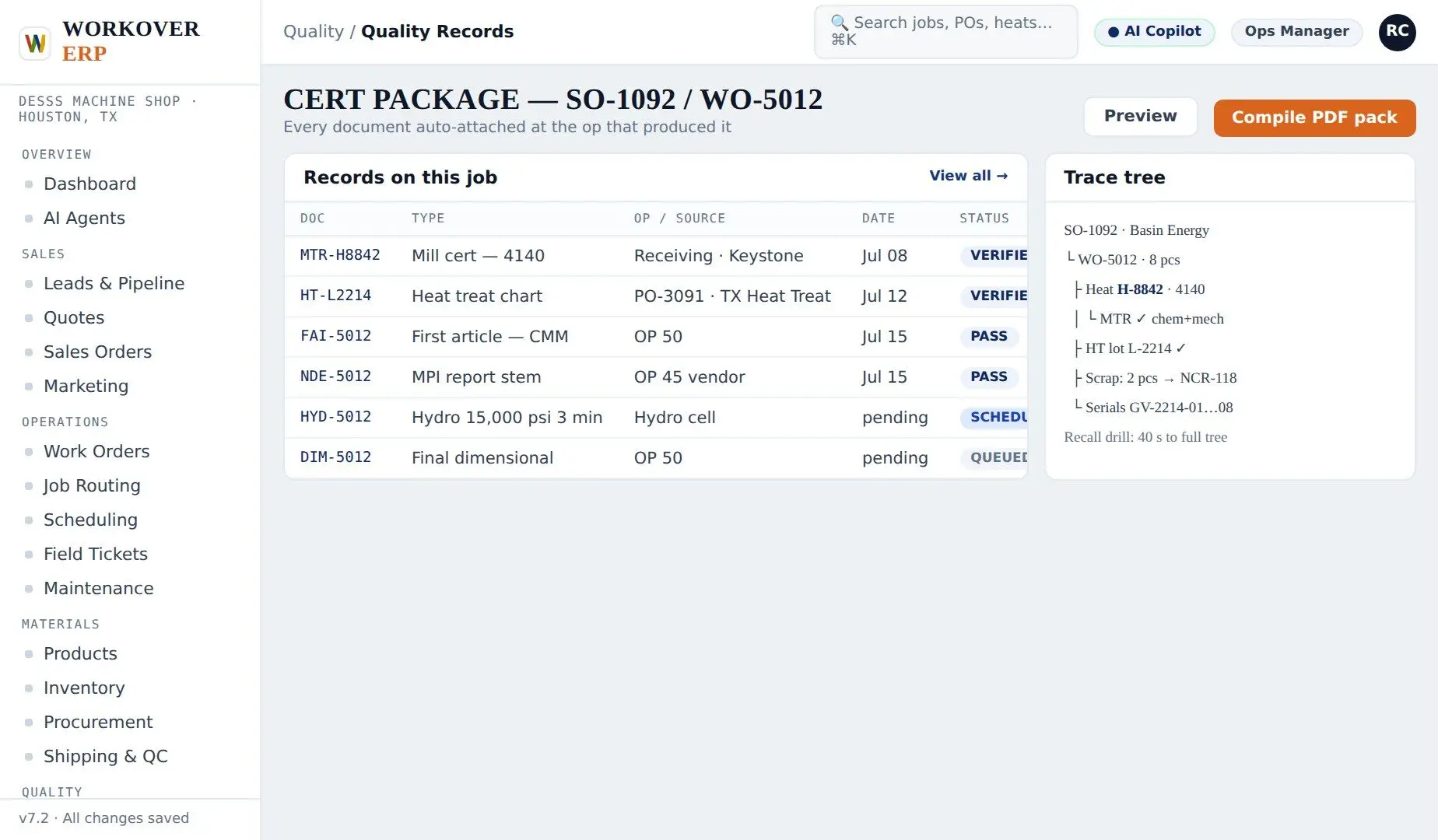
QUALITY RECORDS
Cert packages that compile themselves
MTRs, heat-treat charts, FAIs, NDE reports, hydro certs — attached at the operation that produced them, compiled to PDF when the truck shows up.
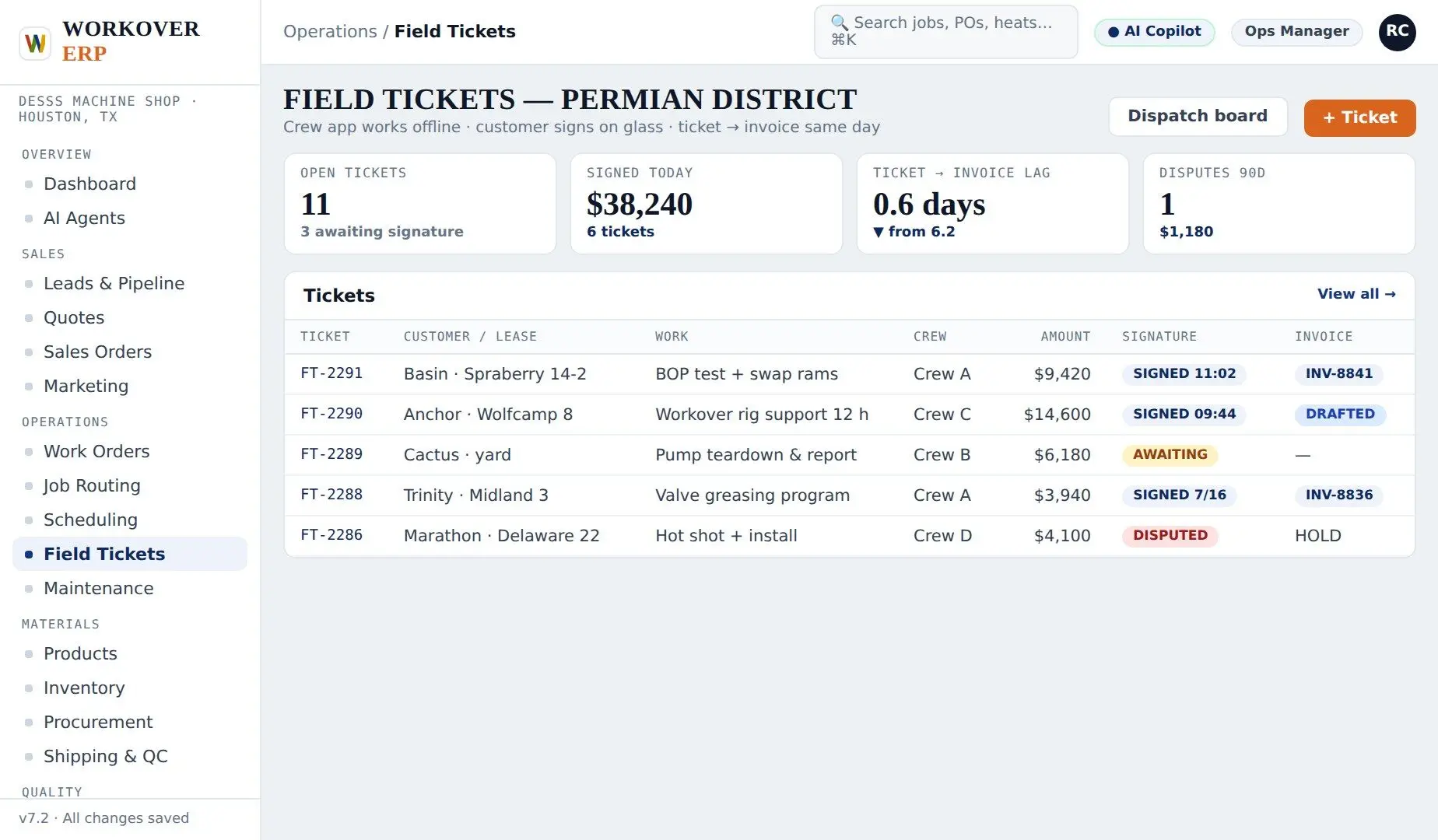
FIELD TICKETING
Signed on glass at the wellsite, invoiced before the crew gets back
The gap between finishing field work and billing it is where service companies quietly finance their customers. Close it to under a day.
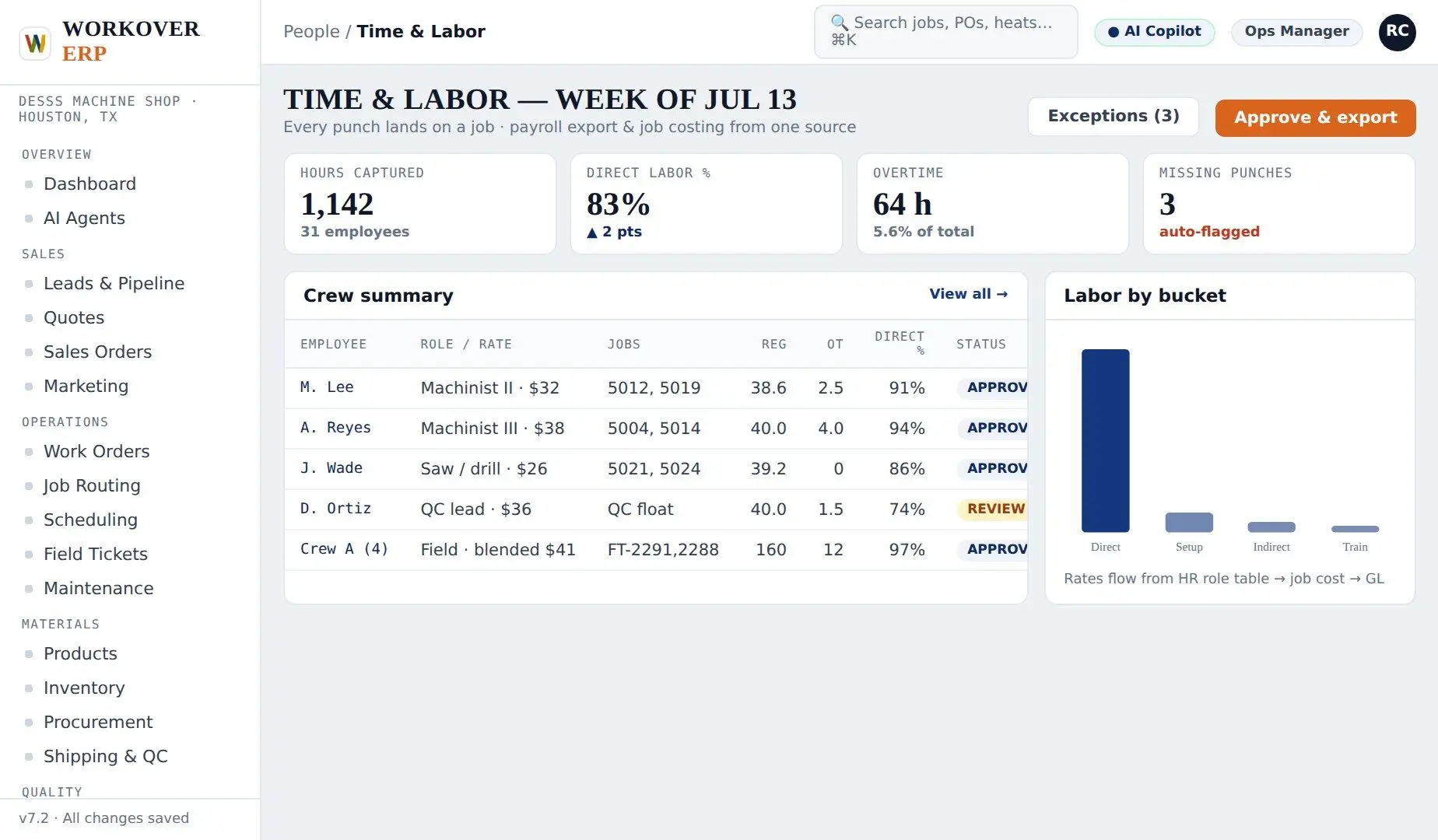
TIME & LABOR + HR
Every punch lands on a job — and HR keeps the rates honest
One time system feeding three masters: payroll, job costing, and the P&L. And an HR module making sure the rates behind them are real.
QUALITY
What API Q1 auditors actually look for in your ERP records
API Q1 audits live and die on traceability, hold points, NCR/CAPA discipline, and attributable records. Here's how auditors read your ERP — and what makes an audit easy.
FINANCIAL ACCOUNTING
The general ledger that posts itself
If accounting re-enters what operations already did, you have two versions of the truth and one expensive month-end. Subledgers should post the GL automatically.
MAINTENANCE
Maintenance on meters, not memory
PMs triggered by spindle hours and miles, breakdowns that reschedule the shop instantly, and downtime with a cost attached.
SHIPPING & QC
The final gate: QC release, cert pack, and BOL in one motion
Nothing leaves the dock without quality's release — and when it does leave, every document goes with it.
MARKETING
Marketing that answers to booked revenue
Trade shows, email pushes, and search ads — attributed all the way to the invoice, because the lead never leaves the system.
MASTER DATA
Parent-child master data: the boring module everything depends on
Customers with many addresses, vendors with remit-to versus ordering desks, employees with roles and rates — get this right and every document downstream gets right with it.
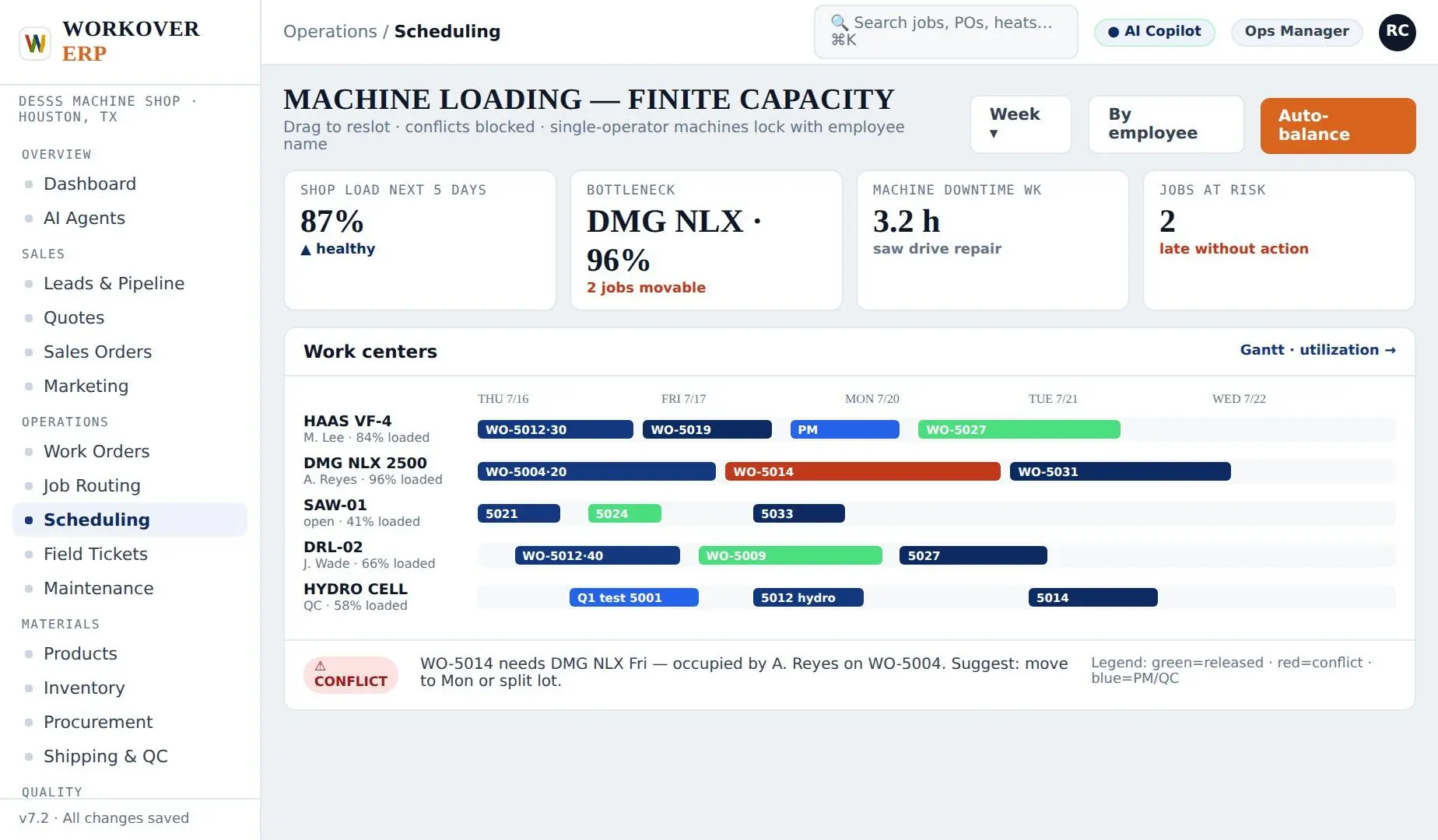
SCHEDULING
Finite scheduling that respects machines and people
Infinite-capacity scheduling promises dates physics can't keep. Finite scheduling loads real machines and real employees — and blocks the conflicts before they happen.
AI AGENTS
AI agents that watch the reports so you don't have to
A copilot you can ask anything, and a dozen agents running on schedules — late jobs, thin margins, aging AR, expiring certs — raising their hands with the fix attached.
OPERATOR EXPERIENCE
A shop-floor screen operators don't hate
ERP adoption dies at the machine. Big buttons, one job in focus, and a time card that fills itself — that's what wins the floor.
JOB COSTING
Estimate vs actual: why month-end job costing is too late
If you learn a job lost margin at month-end, you've already repeated the mistake on the next three jobs. How live estimate-vs-actual costing works, per job and per sales order.
DOCUMENT AI
From scanned PO to sales order in four seconds: how document AI works
How OCR and machine learning turn a customer's PDF, photo, or faxed PO into a sales order with one job per line item — with confidence scores and human review where it counts.